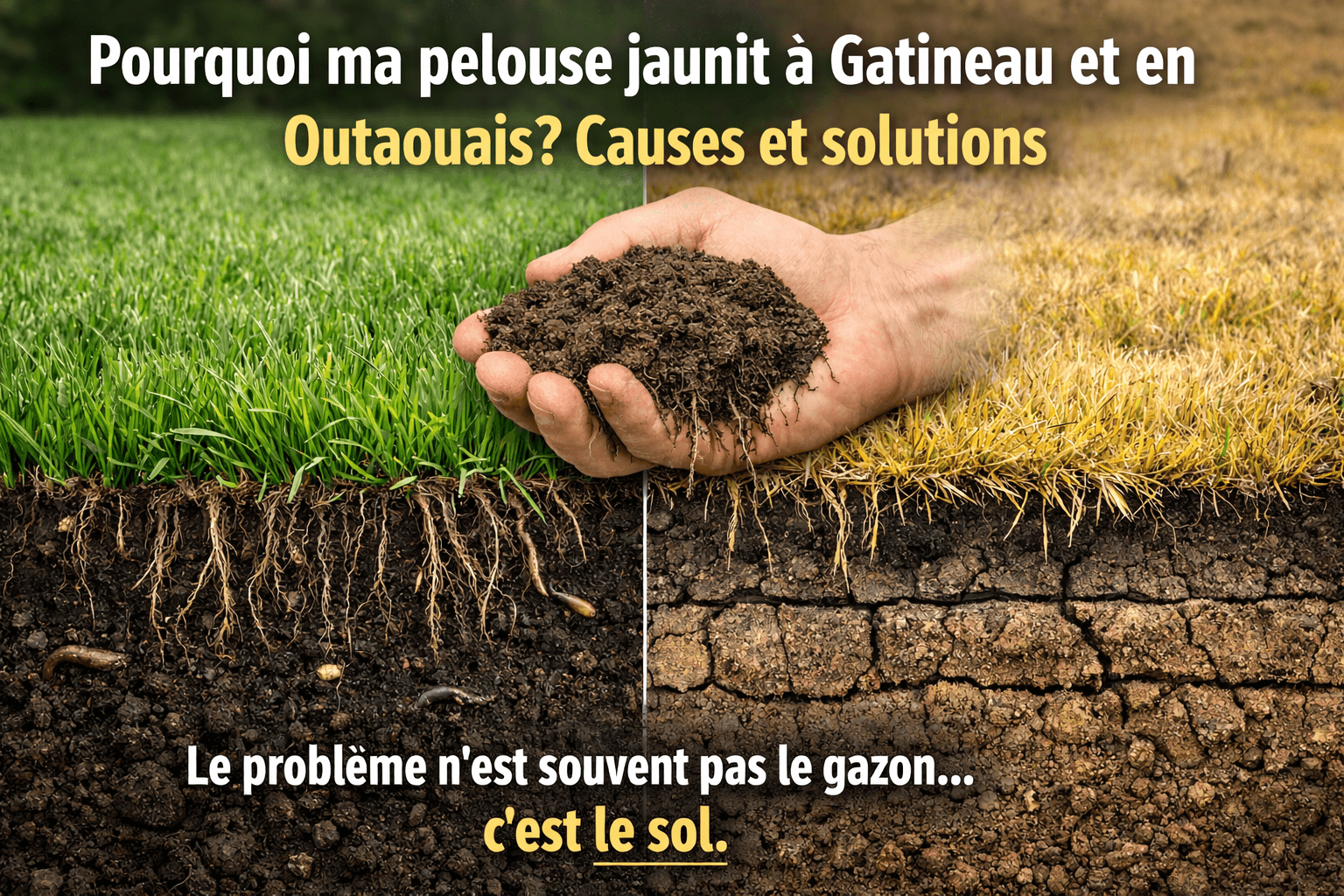
Why is my lawn turning yellow?
Main reasons a lawn turns yellow in Gatineau
A lawn usually turns yellow because of a problem in the soil, in the grass roots or in the site conditions. The most common causes are compacted soil, shallow roots, lack of organic matter, poor drainage, heat stress, insects such as chinch bugs or grubs, or improper use of fertilizers or herbicides.
Most common causes of a yellow lawn
Soil, roots, organic matter, drainage, heat, insects
A yellow lawn is almost always the symptom of a deeper problem: compacted soil, weakened roots, lack of organic matter, poor drainage, heat stress, insects or misused chemicals.
In many neighbourhoods of Gatineau and the Outaouais, lawns are installed on a thin layer of topsoil spread over compacted fill from construction equipment. This limits root development and makes the turf much more fragile.
When the real cause is not identified, people water more and add fertilizer… and the lawn still turns yellow.
Compacted soil
Compacted soil prevents water, air and nutrients from penetrating properly. Roots stay near the surface and the turf weakens.
This problem is very common on newer properties in the Outaouais where construction machinery heavily compacted the soil before sod or seed was installed.
Roots too close to the surface
When roots remain near the surface, the lawn becomes very sensitive to lack of water and hot weather.
As soon as it gets hot, the grass loses its green colour, turns yellow and can dry out in patches.
Lack of organic matter
Soil that is poor in organic matter does not feed the lawn properly and supports less microbial life.
The turf gradually loses vigour and its ability to recover after stress.
Poor drainage
When water accumulates or drains poorly in some areas of the yard, roots lack oxygen.
You then see yellow or thinning spots that stay wet longer after rain.
Heat stress
During periods of heat or heat waves, a lawn with shallow roots turns yellow quickly.
The grass slows its growth, turns yellow and can turn brown if the stress lasts too long.
Lawn insects (chinch bugs, grubs, sod webworms)
Some yellow lawns in Gatineau are not sunburned at all, but actually attacked by insects.
The main turf pests in Quebec are:
- chinch bugs
- white grubs
- sod webworms
These insects attack the roots or the base of the stems and create yellow or brown patches that can expand quickly.
Improper use of chemicals
A lawn can also turn yellow after the application of a chemical fertilizer or herbicide under poor conditions.
Too high a dose, stressed turf, or an application during hot weather can cause turf burn, also called phytotoxicity.
At what temperature should you avoid lawn chemicals?
Safe temperature ranges for fertilizers and herbicides
To reduce the risk of burning your lawn:
Chemical fertilizers
Chemical fertilizers should ideally be applied when:
- daytime temperatures stay below 25–27 °C
- the lawn is well hydrated
When temperatures approach 28–30 °C, the risk of stress and burn increases, especially during hot, dry periods.
Herbicides
For herbicides, it is generally best to avoid applications when temperatures exceed 27–28 °C.
Above 30 °C, the risk of phytotoxicity becomes very high.
How to fix a yellow lawn in Gatineau
Actions on soil, roots and maintenance
The right solution always depends on the main cause: soil, roots, drainage, heat, insects or chemicals.
On many properties in Gatineau and the Outaouais, the key is to improve the soil structure instead of simply applying surface products.
The most effective interventions can include:
- MECHANICAL LAWN AERATION
- TOPDRESSING WITH ORGANIC MATTER
- OVERSEEDING TO THICKEN THE LAWN
- ECO-FRIENDLY FERTILIZATION
- DRAINAGE CORRECTION
In some cases, HYDROSEEDING can be used to establish a dense, uniform lawn on difficult or severely damaged sites.
To correct thin or tired soil, a well-chosen TOPSOIL & SOIL PREPARATION layer before installing or renovating a lawn can make a big difference.
These interventions often restart grass growth and make the lawn more resistant to climatic stress.
Why a soil diagnosis is essential
Finding the real cause before choosing a treatment
Every property is different: soil type, depth of topsoil, slope, shade and how the yard is used.
A yellow lawn can result from a combination of factors such as compacted soil, heat and insect pressure.
At Hortiplan Outaouais, our approach always starts with:
- observing the site
- simple soil tests (compaction, depth, moisture)
- analysis of turf symptoms
A [LAWN DIAGNOSIS IN GATINEAU] helps identify the most likely causes before recommending a targeted action plan.
You don’t see anything at first.
But everything that grows later depends on it.
Lawn diagnosis in Gatineau and the Outaouais
Service areas and long‑term approach
If your lawn is turning yellow or thinning out, a [LAWN DIAGNOSIS IN GATINEAU AND THE OUTAOUAIS] often makes it possible to identify the real cause of the problem.
Hortiplan Outaouais offers lawn maintenance and correction services in:
- Gatineau
- Hull
- Aylmer
- Cantley
- Chelsea
- Val-des-Monts
- L’Ange-Gardien
- Ottawa
To correct a yellow lawn in a durable way, it is often more effective to work on soil quality and root depth than to multiply surface treatments.
You can request a [PERSONALIZED QUOTE WITH HORTIPLAN OUTAOUAIS] to assess your property and plan the right interventions.
FAQ – Yellow lawn in Gatineau
Quick answers to the most common questions
FAQ – Yellow lawn in Gatineau
Can a yellow lawn turn green again?
Yes. In many cases, a yellow lawn can regain its colour once the root cause is identified and corrected.
Can insects make my lawn turn yellow?
Yes. Insects such as chinch bugs, white grubs or sod webworms can damage the roots and cause yellow patches.
Can too much fertilizer burn a lawn?
Yes. An excessive dose of chemical fertilizer or an application during hot weather can burn the turf.
How can I tell if my lawn is yellow because of drought or insects?
Drought usually causes a more uniform yellowing, often on the sunniest areas. Insects create irregular patches where the grass pulls up easily.
When should I request a lawn diagnosis?
You should request a diagnosis if your lawn turns yellow despite watering, if the patches expand quickly, or if you suspect compacted soil, poor soil or a drainage problem.