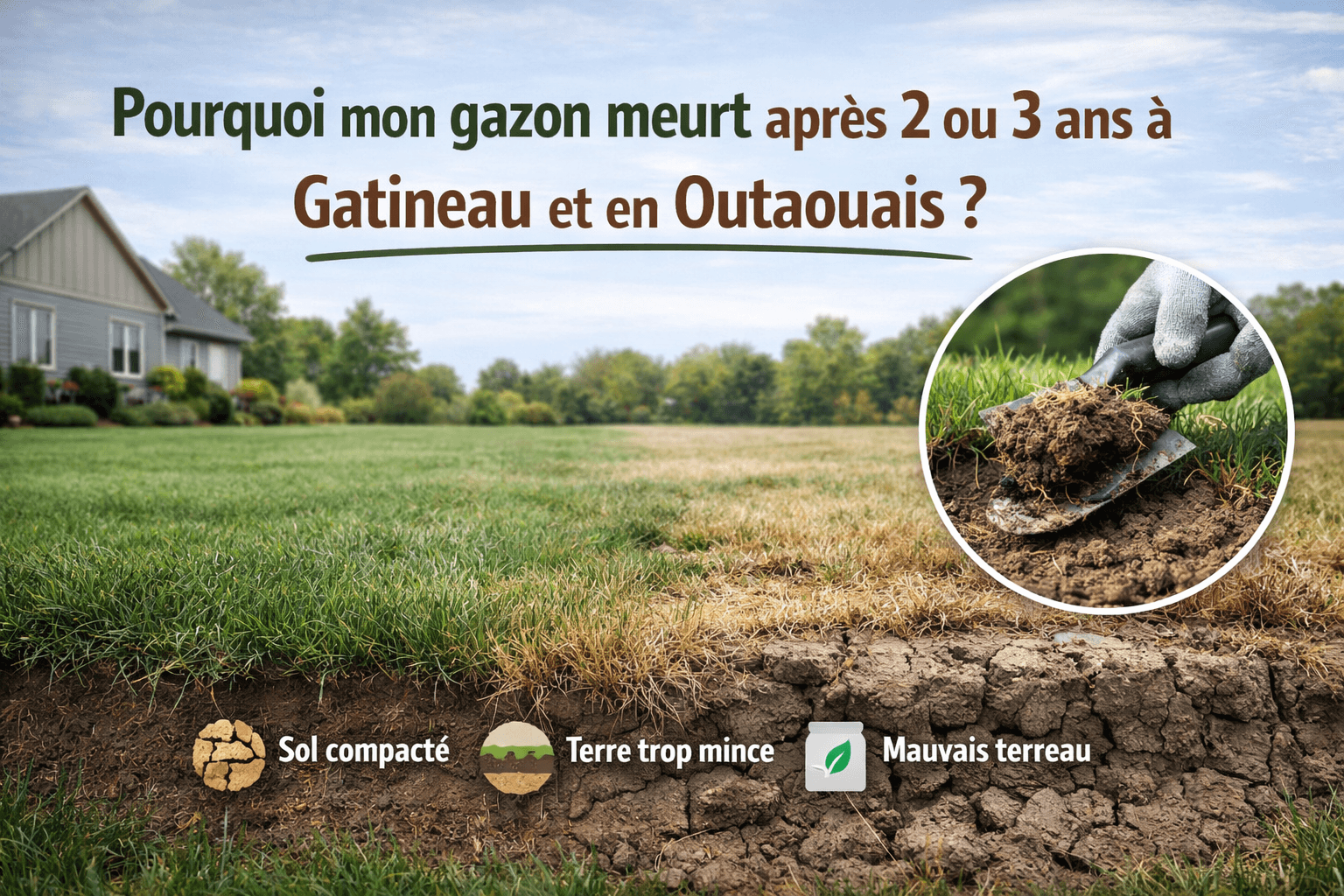
Why does my lawn die after only 2 or 3 years?
Understanding why a lawn looks great at first but quickly declines in Gatineau and the Outaouais region.
A lawn that dies after 2 or 3 years is almost always caused by a soil problem, such as compaction, insufficient topsoil depth, poor soil mix, lack of organic matter or inadequate drainage.
The lawn can look good at first, but it weakens over time when the roots cannot develop properly.
If your lawn turns yellow before it dies, you can also read our article Why is my lawn turning yellow in Gatineau? to understand the early signs of soil fatigue.
The main reasons why a lawn dies after a few years
Beyond watering and fertilizing, soil structure and root depth are often the real cause.
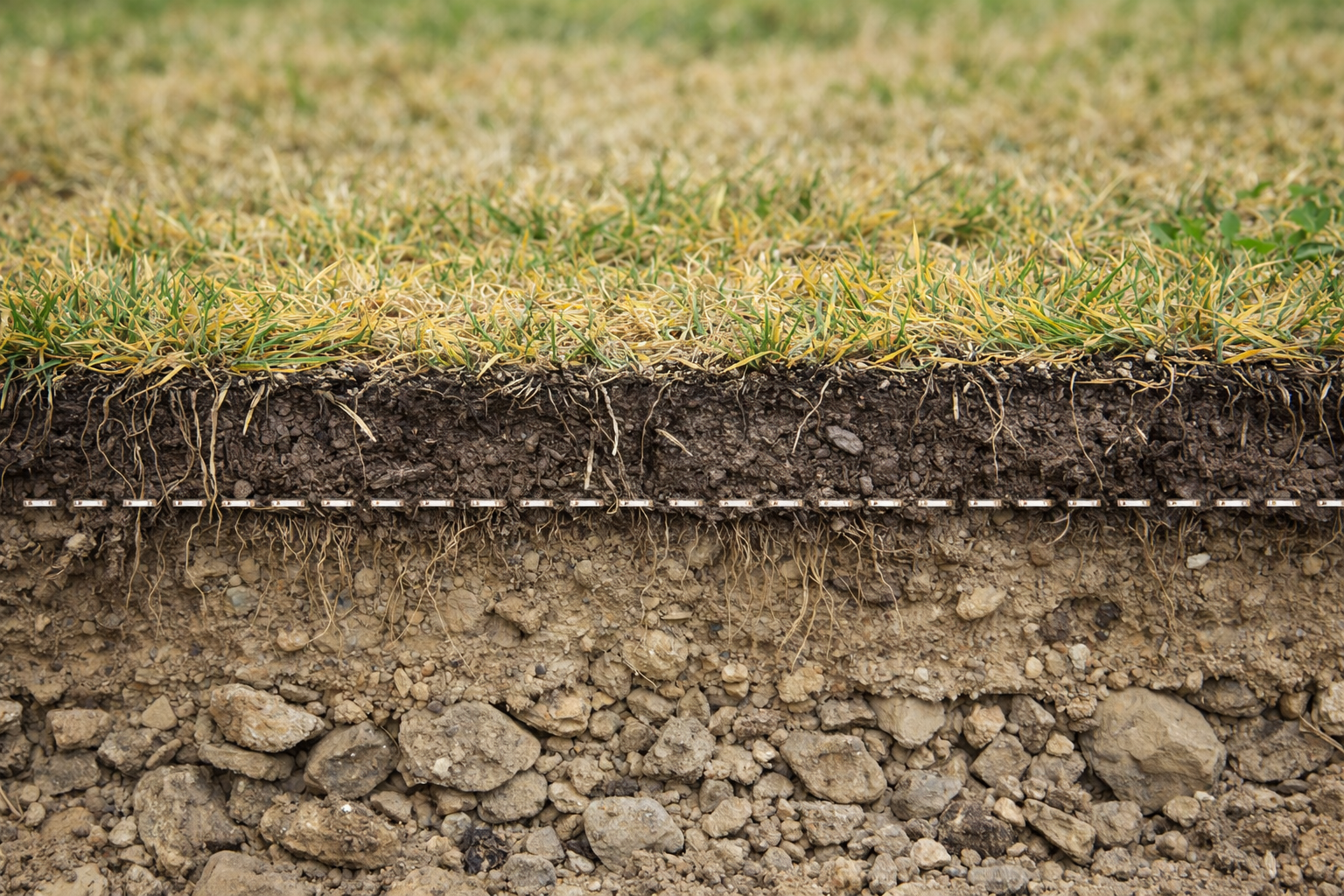
On many properties in Gatineau and the Outaouais, the lawn is installed on a thin layer of topsoil placed over soil that has been compacted by construction machinery.
At first, the lawn looks good.
- it turns yellow
- it thins out
- it becomes weak
- it no longer tolerates heat
The problem is not the grass.
It is what lies underneath.
Soil problems that cause a lawn to die
Compacted soil, poor-quality topsoil and shallow roots gradually weaken your lawn.
Compacted soil
Compacted soil blocks the circulation of water, air and nutrients. Roots stay close to the surface and the lawn becomes dependent on frequent watering.
Insufficient topsoil depth
This is one of the most common problems in the Outaouais. A topsoil layer that is too thin:
- limits root development
- dries out quickly
- does not hold nutrients well
Result: the lawn does not last over time.
Poor soil mix choice
Not all soil mixes are suitable for a lawn. Some products:
- contain too many fine particles
- compact quickly
- retain water poorly
- encourage weed growth
A poor soil mix can give a nice short‑term result, but a medium‑term failure.
Poor soil quality
Soil that is low in organic matter or poorly structured cannot support a long‑lasting lawn. Without microbial life and a stable structure, the turf weakens quickly.
Roots too shallow
When roots cannot go deep into the soil, the lawn becomes:
- sensitive to heat
- prone to drought stress
- unstable over time
Inadequate drainage
Soil that holds too much water or does not absorb it properly weakens the roots. You may see areas that stay wet longer and then thin out.
Poor maintenance or bad practices
Misused chemical fertilizers or improper watering can also speed up the decline of a lawn. For example: fertilizer applied on stressed turf, very shallow watering, mowing too short, etc.
Why the lawn dies after 2 or 3 years
The lawn looks good at first, but the roots eventually hit compacted soil or an insufficient layer of topsoil.
At first, the lawn uses the nutrients available in the surface layer of soil. It can look very nice during the first or second year.
Later, the roots need to grow deeper to reach water and nutrients, but they hit compacted soil, a layer that is too thin or a poor soil mix.
That is when problems start: the lawn weakens, the turf turns yellow, thins out and eventually dies.
If your lawn turns yellow without dying completely, the mechanisms are similar to those described in the article Pourquoi ma pelouse jaunit à Gatineau.
How to fix a lawn that keeps dying
From aeration and topdressing to rebuilding the soil base and installing a new, durable lawn.
The right solution always depends on the cause of the problem.
In many cases, homeowners try adding fertilizer or overseeding, but the problem comes back because the soil base itself was never corrected.
The interventions can include:
- MECHANICAL LAWN AERATION
- ADDING ORGANIC MATTER THROUGH TOPDRESSING
- OVERSEEDING TO THICKEN THE LAWN
- ECO‑FRIENDLY FERTILIZATION
These interventions help improve soil structure and root health.
However, when:
- the topsoil layer is too thin
- the soil is highly compacted
- the structure is very poor
partial correction may not be enough.
In some cases, it is better to rebuild the soil base to achieve a long‑term result.
HYDROSEEDING can then be used to establish a new, durable lawn.
Lawn assessment in Gatineau and the Outaouais region
A site-specific diagnosis to identify soil, drainage and maintenance issues before investing in major work.
Every property is different.
A dying lawn can be caused by several combined factors: soil, topsoil, drainage or maintenance.
At Hortiplan Outaouais, we regularly analyze this type of issue on residential properties in Gatineau, Hull, Aylmer, Cantley and Chelsea to identify the root cause and propose long‑term solutions.
We specifically look at:
- soil compaction
- the actual depth of topsoil
- the quality of the existing soil
- how water behaves after rainfall
- the condition of the roots and turf
If your lawn dies after a few years, a proper assessment often makes it possible to identify the real cause of the problem before investing in work or products.
Hortiplan Outaouais offers lawn assessment and remediation services in:
- Gatineau
- Hull
- Aylmer
- Cantley
- Chelsea
- Val-des-Monts
- L’Ange-Gardien
- Ottawa
To fix a lawn in a sustainable way, it is often more effective to improve soil quality and root depth than to multiply surface treatments.
Frequently asked questions about dying lawns
Quick answers to the most common questions we get about lawns that decline after only a few years.
Why does my lawn die after only a few years?
A lawn dies after 2 or 3 years when the roots cannot develop properly, often because of compacted soil, insufficient topsoil depth or a poor soil mix.
Is it the grass or the seed’s fault?
In the vast majority of cases, the seed is not the problem. The issue usually comes from the soil itself, its depth, its compaction or its quality.
Can the problem be fixed without redoing everything?
Yes, in some cases, correction through aeration, topdressing, overseeding and maintenance adjustments can improve the situation. But if the soil structure is too poor, a partial or complete reconstruction may be necessary to get a long‑lasting result.
How much topsoil is needed for a durable lawn?
A sufficient depth of quality topsoil is essential to allow the roots to grow deep and withstand heat and drought. A layer that is too thin limits the lawn’s longevity, even if it looks great at first.
When should I request a lawn assessment?
You should request an assessment if your lawn dies or declines after only 2 or 3 years, if it turns yellow or thins out despite your efforts, or if you suspect compacted soil, poor topsoil or a drainage issue.